
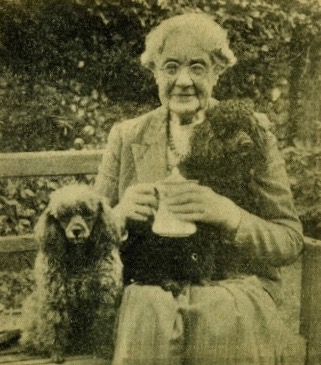
Towards the end of her life Louise Hoare, Richard Hoare’s daughter, wrote and self-published two short memoirs. She recorded these precious memories while living at North Cottage, sitting in the very rooms where you are possibly reading this page.
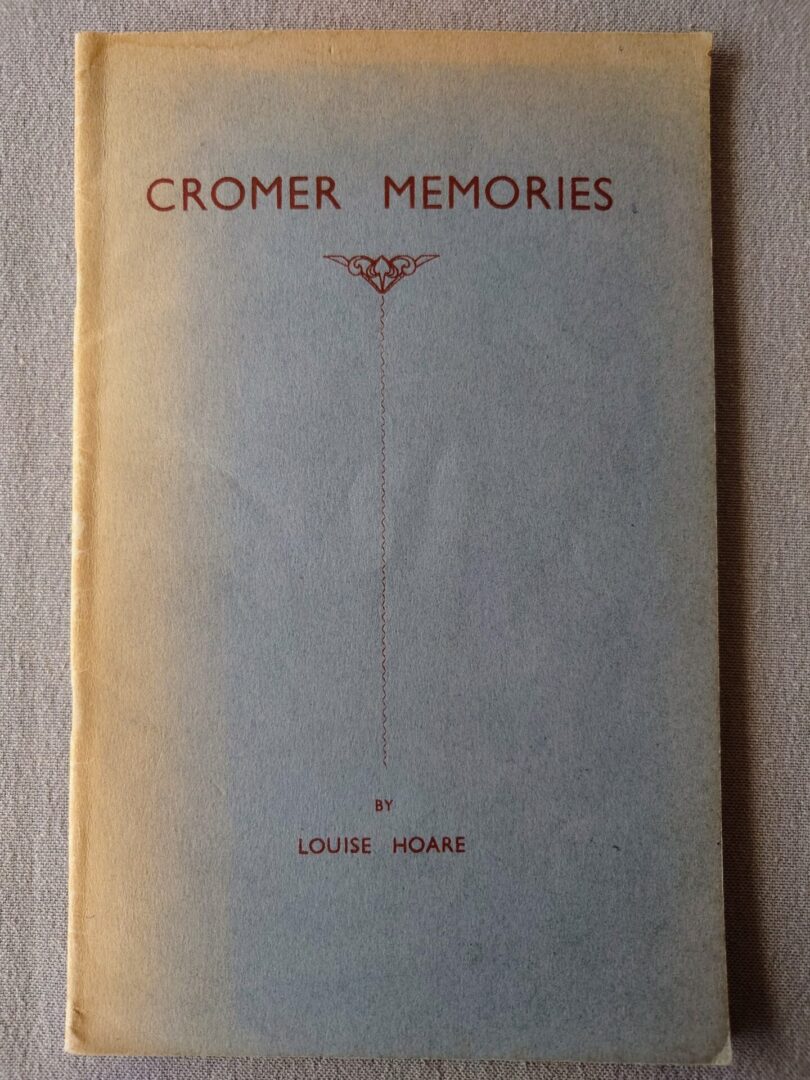
This is a transcript of the first volume “Cromer Memories” published in 1956, the year after her 80th birthday celebrations. The memoir isn’t dated but in Chapter VI the text remembers the death of Mrs Bond Cabbell “at the beginning of last year (1955)”.
Through the memoir Louise looks back over a long and happy life and the changes she has witnessed. It is a fascinating account of Victorian Cromer as it transitions to the modern resort it was becoming by the 1960s.
We don’t know how many copies still exist, but self–published memoirs of the 1950s were hand-set in lead type. This was a laborious and expensive process, and printers such as The Lancaster Press of Fakenham who produced this one, recommended a print run of at least 250 to 1,000 copies. 250 copies was easily sufficient if the memoir was only intended to be distributed to family and friends.
Survival rates for these rare memoirs is low, so there may be a handful of copies remaining today. We have an original copy purchased online in 2020 from Leakey’s Bookshop in Inverness. We have no idea how it ended up in Scotland. We know only of two other copies, one is listed in the archive of Norfolk Museums Collections and the other is owned by a Cromer neighbour whose parents received a copy as a Christmas gift in 1957. An original festive greeting card (sadly not from Louise) is tucked inside the front cover.
Inside the 32 pages of this slim volume, Louise describes her first arrival in Cromer by train, the annual visits with her family and eventually coming to live in North Cottage, which her father bought and considerably extended. She describes the Hoare’s private estate, created by her father, being transformed into a public park in 1929 when North Lodge was sold, and her subsequent surprise at the family stables becoming a tea-room, and later when a boating pond was constructed outside her front gate.
There are wonderful portraits of some of Cromer’s leading characters including Henry Blogg the legendary lifeboat coxswain. Louise also describes her time living in Cromer with her companion, the widowed Lady Sanderson – Averil Sanderson Furniss (1873 November 26 1962), who accompanied her each year when she over-wintered in Torquay, which is where Louise eventually died.
The Hoares were renowned Quakers, abolitionists, and campaigners for social change when such activities were considered remarkable. They wrote pamphlets, spoke in Parliament and provided financial support in the campaign to abolish slavery. These are Louise’s memories.
Below is the full text of Louise’s wonderful memoir – complete and uncorrected.
Cromer Memories – Louise Hoare
CHAPTER I
The first time that I came to Cromer was in the autumn of 1875. I cannot pretend to remember my impressions of the place then as I must have been about three months old: as long as I was warm and well-fed, nothing else mattered!
My parents lived in Hertfordshire, and each year visited Cromer when the partridge shooting began. My father loved the place as he had come here every year of his life, and his parents and grandparents before him. It was the custom in our family for all of us to meet here each autumn—uncles, aunts, first cousins, second cousins, third cousins—so that we had companions of all ages to enjoy. Children always love a move—the packing up of ourselves and the household with piles of luggage, boxing two or three horses and several dogs, made an exciting start.
We packed into a crawling train at Hertford, and by slow degrees reached Cambridge. There we had a quick rush for buns, etc. (no corridor trains in those days). If brothers or cousins were undergraduates, they generally met us at Cambridge station. I still remember a large box of chocolates which my eldest brother brought me !
After what seemed an endless day we drew near to Cromer. At Gunton station we began to stand by the carriage window. Who would see the lighthouse first ! Then the sea. When we jumped out onto the platform at Cromer High Station we saw the loveliest view of Cromer—the sea and the beautiful church with its high tower standing in the centre of the old town, looking like the guardian of ocean and village. Then came the mad rush down the hill and straight on to the beach, the grown-ups following in the station bus—a rattly old thing with one horse. It always had a peculiar smell of old straw and stuffiness.
The first years of my life we stayed at Brunswick House on the terrace overlooking the gangway. My eldest brother and sister remembered travelling by stage coach from Norwich: the railway line stopped there. How all their belongings arrived I cannot imagine ; no coach could have carried them. My father rented Brunswick House for many years. In 1886 my uncle, Joseph Hoare, died, leaving North Lodge and the adjoining fields to my father, Richard Hoare.
About 1898 he bought the schoolmaster’s cottage adjoining North Lodge Estate. North Cottage had a nice garden in three small plots. The house, like North Lodge, being built of uncut flints off the beach. At the end of the garden stood a small boys’ school, all that part of the property being owned by the Goldsmiths Company. The school was eventually turned into what is now the doctor’s house because a large mixed school was built in the town.
In 1901 my father died. My eldest brother, Douro, moved into North Lodge, my sister Helen, brother Dick and myself in to North Cottage (where I still live). On my garden wall is a slab saying it was the property of the Goldsmiths Company.
My father took immense trouble over North Cottage, building on four good rooms and furnishing it. He said he hoped that we would never sell it as he liked to feel that we should always have a roof over our heads.
In my next Chapter I will try to describe Cromer as it was in those long, long ago days, and the many changes I have lived to see here. It may be my imagination only, but I feel that in spite of many changes it is still a place of peace and goodness. The past generations of Godly people have left an atmosphere still felt by visitors and newcomers. Sitting with strangers on the seafront, they have often told me this. They come year after year for the peace and real rest which the old place gives them.
For this reason I personally should like the tradition to continue of quiet Sundays, peaceful shore and seafront, where families can enjoy each other and their children. Give them good music, good acting, and perhaps a place for teas and quiet. Let us keep Cromer somewhat as it has been.
But this is the voice of an octogenarian, and will probably cause a smile amongst the young generation.
CHAPTER II
In my first chapter I described our arrival at Cromer—a large party of children, dogs and grown-ups. My Nanny Warner was the most important member of the party. She loved Cromer and often told me of the different men who had proposed to her (I wonder if they really did!).
I will now tell a little of what the autumns here meant to us, and our daily life in the place. Later I hope to describe what Cromer itself was like 70 years ago, and the very outstanding personalities we met and mixed with. I, being the last of my generation, can remember so many who have passed and gone, but who left too strong a mark to be forgotten. The long generations of fishermen whose families stretch back hundreds of years into the past—Cromer really belongs to them—the same names going on and on from father to son, braving the terrors of this often cruel sea, starting out to crab when the rest of the town is still asleep.
From them are chosen the splendid lifeboats crews who at the risk of their own lives have saved so many people. Mr. Blogg was the world famous coxswain, winning the George Cross and almost every other medal possible. A great man and I am proud to say an old and personal friend of mine. Their names go far back into history: Mayes, Cox, Davies, Blogg, Allen, Harrison and many others.
To go back to my own memories. After our tedious journey here each year and our arrival at Brunswick House came an enormous tea, then the unpacking and settling in. The lodging house furniture must have seemed a bit drab after the comforts at home but I do not think we cared much or even noticed it! Here the big bow windows looked straight down to the sea, and we went to sleep with the lovely sound of the waves breaking on the shore below, and the smell of salt air and seaweed.
My father rented shoots from relations and friends. They shot with him or he with them two or three days a week. These were generally family parties consisting mainly of sons, brothers, cousins and nephews. His nephew Samuel Hoare, owned a good deal of land round Cromer: so did various Buxtons, Gurneys and Barclays.
In 1886, when we moved into North Lodge, our shooting party generally met in the drive in front of the house. Each shot had his gun and retriever. A good many swear words passed between the various dogs. My impression of the start is a strong smell of pipes and cigars, my father on a grey horse, the others in dog carts or rough game carts. We often joined them for a picnic luncheon under a hedge or haystack, afterwards “walking” with the shooters.
For some years Mr. Gurney Barclay rented Northrepps Woods from the Gurneys. In this wood stood a large barn, to which each year the Barclays asked a party to luncheon with wonderful Irish stews and a great deal to eat. Afterwards came the pheasant shoot in the Green Drive, where rocketing pheasants were killed by the very best shots. It is a lovely wood and looked beautiful with the autumn tints, though falling pheasants spoilt it for me for I hated to see things killed.
The days we did not walk with the shooters we rode in large parties on the beach, Lighthouse Hills or in the country lanes and fields around. The smaller children dug and paddled happily on the shore while some of our party bathed. In those days bathing machines were pulled into the sea by a horse, generally ridden by a small boy. The bathers stepped down the ladder into the sea clothed from neck to knee in blue bathing gowns trimmed with scarlet tape. There was no mixed bathing then.
As the autumn went on and the days grew shorter we had children’s tea parties in each others’ houses. We had Swiss rolls with sugar on the top and there were red and white sugar mice on everyone’s plates. These came from Mr. Breeze, whose shop in High Street absorbed a good deal of our pocket money. After these teas came noisy games all over the house: one we especially enjoyed was called “Rats and Ferrets”. For this the room was darkened, each child found a place to hide in, and the ferret, another child, crept round feeling for victims. It was a most exciting and creepy game and gave most of us nightmares the night following.
Our greatest treat was the donkey drives to the Black Beacon. Ben Kettle had several wicker chaises, of which we hired as many as we could. With one donkey boy between us we drove at snail’s pace for two miles there. Then wild games of hide-and-seek ensued amongst the trees and heather, with beautiful views over West Runton, Beeston and Sheringham.
Mrs. Kettle lived for many years after Ben’s death, she being several years his junior. Indeed she died only last year. She loved all animals, especially the donkeys her husband used to keep, and she was in the habit of taking in stray dogs and cats and giving them a comfortable home. I often saw her surrounded by them.
CHAPTER III
Since the floods along the coast in 1953 the shore has very much changed. There used to be patches of rocks at low tide and these had small pools and streams full of treasures. Now they have nearly disappeared.
Our favourite amusement as children was to clamber about on these rocks, findng tiny crabs, sea anemones, coloured stones, lovely seaweeds and many other interesting things. Jelly fish we never touched as one of them had stung Ronald Buxton pretty badly, giving him a poisoned hand and arm.
We collected lovely things in small pails to take home, never remembering that the poor things would die and lose all their beauty in a few hours. Half the fun was getting thoroughly wet and untidy, jumping about from stone to stone and often slipping into the little pools. Sometimes when the sea went down we had rides along the hard-sands—and in those days one could go round the ends of the breakwaters—cantering and racing each other for miles along the beach.
We went as far as Sidestrand: I do not remember riding further. We knew when we had reached Sidestrand by the ruins of an old wall at the bottom of the cliff. This had fallen over in a landslide from the cliff top above. These cliffs are covered with scarlet poppies most of the summer, and the old churchyard used to be full of them. This inspired Robert Scott’s song (much sung at that time) “The Garden of Sleep”, beginning “Where the poppy flowers grow”. A drinking trough in Scott’s memory was put up on the Overstrand Road at the fork leading to Northrepps.
Sir Samuel Hoare built a very pretty little church, to take the place of the old one, in Sidestrand village and much further from the edge of the cliff. I believe he used all the stones from the old church.
I enjoyed the riding parties but still more the beach rides alone with my father and his dog. My father was deaf and the beach was so solitary, so completely lonely, that we could talk freely without fear of being overheard, with only the waves and the sea gulls to listen to us. We often rode on the Lighthouse Hills or in the lanes and fields in the country round.
The winters at Cromer are not so pleasant. Bitter winds rush in from the North Pole for there is no land between us to break the icy blasts. It is on winter nights that we more often hear the ominous sound of the rockets.
This means that a ship is probably in trouble somewhere! The lifeboat men rush down and launch out in an astonishingly short time. They have often rescued a crew off the Haisbro’ Sands, putting into Yarmouth harbour as we have no safe landing place on a stormy day or night here.
In olden days the townspeople rushed down to help with the launching as the only lifeboat then was kept on the gangway and had to be pulled by ropes into the sea. I remember a little man (who was on a visit to the town from London) running to help, who told me afterwards that he had stopped pulling when he reached the waves because he did not want to get his feet wet! The Cromer men often had to wade in up to their waists in the bitterly cold water. The anxious times the women at home go through is not difficult to imagine when one sees their men starting off in those awful seas. Their courage is almost as great as that of the men themselves.
The “Henry Blogg” lifeboat now starts from the end of the pier which makes the launching much quicker and easier. The 2nd lifeboat still goes from the gangway house. The small wooden jetty which we used to have was far more picturesque that the present Pier but it was found unsafe and pulled down, part of it being destroyed in a storm. I remember standing on it in rough weather and feeling the old timber rock and tremble. The wind was so strong that we could hardly stand.
Our Cromer lifeboat has a great reputation : the lives saved run into thousands. One special rescue they made always stays in my mind. They went out on an awful night to a vessel wrecked on Haisbro’ Sands. After saving the whole crew of Italians, they started home and had just turned when one of the sailors said that they had left their St. Bernard dog on deck. Without any hestitation Coxswain Blogg turned the lifeboat back and himself rescued the dog from the sinking ship. He gave it a home for many years and “Bondy” was a well-known figure in Cromer, walking at Mr. and Mrs. Blogg’s heels or barking at the waves. Coxswain Blogg died last year and we all miss his familiar figure, standing on the sea front or on winter evenings talking over his fireside.
CHAPTER IV
Sundays at Cromer were very strictly kept in my childhood. We had to wear our best clothes and keep clean and tidy all day—no beach, no games, no paddling about in sand-shoes. I don’t remember ever feeling the day long or irksome, there was so much else to do.
The whole family walked off to church, and, my father being deaf, we always sat in the front row. When the chancel was built in 1895 he put in an extra pew in front of the right aisle so that he could follow the service. He could never hear the sermon, so always read a sermon book—but not before explaining the reason to the preacher.
I generally sat by him, so that my favourite pastime in a long service was a bit difficult. I liked to count the carved wooden angels above the clerestory, which meant staring straight up. Still more interesting was to see how many relations were in church, which meant twisting about a bit. One Sunday I found eighty!
Mrs. Gurney Barclay drove to church in a small pony chair, surrounded by children and grandchildren. The vast size of the church, after our little village church in Hertfordshire, always impressed us. There, our voices seemed to fill the place: here, with the high roof and vast space, the sound was so very small, with Kate Fitch on the wheezy old organ, and a very small choir, if there was one at all. I do not think they had one until years later, when the ruined chancel was rebuilt and a new organ installed. In very early days we only sang the hymns.
Several times I remember the rocket going off in the middle of the service and fishermen in blue jerseys tramping out of church. Then everyone would start to sing the hymn:
“Eternal Father, strong to save,
Whose arm doth bind the restless wave,
Who bidst the mighty ocean deep
Its own appointed limits keep.
O hear us when we cry to Thee
For those in peril on the sea.”
This made us all fell very choky, thinking of the, perhaps sinking, ship in those huge waves, tossed about by the howling winds; then of our friends, the lifeboatmen, risking all to save these strangers.
At the end of each service Mr. Fitch disappeared into his vestry, shed his surplice, and returned to preach in a black gown. It always amused me to see how quickly he ran up the pulpit stairs. Mr. Fitch was first of all Curate and then Vicar for a total of 55 years. He retired when he was a very old man and died in 1897 at his house in Cliff Avenue, where he lived after giving up the parish.
He was very much loved here, and his photograph still hangs in many of the houses. Everyone went to him or sent for him in their joys or sorrows, in good health or in illness. His sympathy and goodness never failed; he was a kind and very dear old man. His vicarage was an open house to us all. I often went there as a small child, and always received a warm welcome. I was one of the many who loved and depended on him. Mrs Fitch died before I can remember.
Their four daughters were very remarkable women. Three of them did not marry and devoted their lives to the church and parish. They ran the Sunday School, visited the sick, and were always ready to help anyone who needed them. They were artistic and amusing and joind in everything. Their greatest friends were the Buxtons at Colne House. When Lady Buxton grew old, Mary Fitch lived with her and helped to look after her—she was with her until she died, at the age of 93.
Any of the older people in the place will talk of Mr. Fitch and the “young ladies”—Edith, Mary, Kate and Alice. They were rather plain but so full of wit and good sense that no one noticed this. It was only a few years ago that the last Miss Fitch died. After their father’s death they did everything possible to help his various successors, and were very broadminded over the changes that gradually came into the church—the new organ, trained organist, surpliced choir and many other improvements.
Cromer now has a beautiful organ, a large well-trained choir, with a very musical organist. We also have very good sermons and the church in summer is crammed, and fairly full all the year round. When the new chancel was finished, various people gave stained glass windows: one in memory of Mr. Fitch and another of Mr. Bond Cabbel: one to the Buxtons, another to the Hoares and another to Miss Herring. These all went in the bombing but have now been replaced. The best window, made of really old glass at the West end was entirely shattered. The bitter cold of church services for weeks after the air raid was quite awful. We were all thankful when the Methodists lent us their warm chapel.
The first people to subscribe to our church after the bombing were a Roman Catholic lady and the Roman Catholic priest. Their little church is well attended, as are all the chapels in the town. Sunday still means much to most of us in Cromer.
CHAPTER V
My father, Richard Hoare, died in 1901 at the age of seventy-six. The stories that he told us must go back about 120 years. I have one of his diaries, written in 1834-5 at Northrepps Hall, where he was staying with his aunt and uncle, the Fowell Buxtons. He describes the news coming of the emancipation of the slaves in 1835—Mr. Wilberforce and his uncle, Sir Thomas Fowell Buxton, had been striving after this for many years.
The slave trade had been a heart-breaking tale of cruelty and injustice—a serious blot on a Christian country which had carried on with it for so long. Wilberforce and Buxton had a hard struggle to get the Bill passed in Parliament.
Another mention in his diary is of the Misses Gurney, at Northrepps Cottage. These old ladies had helped to start the Cromer lifeboat. He told of how they went down to the beach in raging storms to encourage the men. One of these ladies was a cripple, and there is still an iron handle fitted in the porch which helped her to get into her bath chair. His aunt, Elizabeth Fry, the prison reformer, was in close touch with his parents. His early impression of her was that she made him “feel good”.
The present golf links was open space where most of the Cromer people walked, especially on Sunday afternoons. In his boyhood the old ruined lighthouse still stood on the edge of the cliff. Before I can remember it finally toppled over on to the beach below. One day my father told us, he was riding alone on the Lighthouse Hills when as he approached the ruin he saw a tall man in a dressing gown standing at the door. He felt very much surprised and jumped off his pony to see who it could be. Though he thoroughly searched the ruins and looked all round, he could find no one there!
In my life-time I have seen many changes in Cromer. The golf links opened about 1895, and we were all made original members, which meant the payment of a very small subscription for the rest of our lives. Some of the holes have gone over the cliff edge, but the course is still a very pleasant place, with the larks singing, the sea below, the green hills to walk on, and the woods and fields around.
Suffield Park hardly existed 50 years ago. Mill Road, now busy with buses and cars and with houses on either side, was a small muddy lane. “Old Shuck”, the phantom dog with the tea-cup eyes, was supposed to run from Mundesley to Sheringham, taking Mill Lane on his route.
This gave the place a bad name after dark (anyway for children). One man told me he had seen him. I wonder!
All Cliff Avenue was fields not so very long ago. The Runton roads had cliffs and fields on either side. That part of the country was filled with wild flowers, some very rare Vipers Bugloss turned the clifftop blue. That country was a botanist’s paradise for on Beeston Bog one found Grass of Parnassus, Dodder and other treasures.
Ornithologists see many interesting birds along the coast to Cley and Blakeney and on the Point, where there is a celebrated sanctuary. I was told of a bird which had been caught and ringed at Blakeney being picked up in South Africa three years later. Cley and Blakeney, Wiveton and Morston had a terrible flooding in 1953: much damage was done and some lives were lost.
To return to Cromer itself. Remains of a pre-historic village were found near the Pier, and flint instruments (among other things) were shown me by Mr. Savin, the collector, and by Frank Barclay. Old James Mayes, one of the fishermen, had a collection of fossils and a piece of amber with a fly in it. He told us many interesting tales, one of which I never forgot. He had been nearly drowned but resuscitation fortunately brought him back to life. His words to me afterwards were “Though I dearly loved my wife and children, I did not want to come back. It was all so beautiful. I saw every lovely colour”.
Billy Mayes was another well-known character here. He had club feet but carried on in spite of them. His photograph was in the shop windows not so long ago. We had a Town Crier dressed in uniform, who rang a loud handbell and then called out lost goods or coming events in the town.
The Rocket Garden was a dirty gully filled with refuse and old pots and pans. Most of Cromer’s bigger houses are now turned into hotels. For instance, there are Cliff House (belonging to the Samuel Hoare’s), Colne House (belonging to old Lady Buxton), the Grove (the Birbecks and the Barclays), and Newhaven Court, which was owned by the Locker Lampsons. The Warren is now a girl’s school, and North Lodge, once Richard Hoare’s house, is the District Council Office.
Cromer Hall is still a private house. It’s late owner, Mrs. Bond Cabbell, was a well-known lady in Cromer. She lived here for seventy years, knew nearly everyone in the place, and was beloved of all. I will speak more of her in my next chapter.
CHAPTER VI
In my last chapter I mentioned Mrs Bond Cabbell. She came as a bride to Cromer in 1883, having married Benjamin Bond Cabbell who owned Cromer Hall. Before her marriage she had been Evelyn Grazebrook. She was very lovely, with a beautiful figure and golden hair. She was only 19 when she married. Many times she told me of her first arrival as a young bride and of how the Cromer people unharnessed their horses and pulled the carriage home.
Cromer Hall stands just outside the town in lovely woods and fields. It has a large, well-kept lawn at the back of the house bordered by beach trees. Mrs. Bond Cabbell often lent her garden for Church or garden fêtes, and her fields for gymkhanas. The Bible Society meeting was held annually at her house.
She was interested in all her neighbours, rich and poor, and very sympathetic with anyone in trouble. I remember one friend she visited who was feeling very lonely after her sister’s death. Mrs. Cabbell said, “When a baby is born into the world it finds kind loving hands to greet it and care for it. So it will be when we die. We shall find welcome and love there a hundred times greater than here. So there is no need to be anxious for the ones who have gone.”
Her husband died when she was still very young, and she told me that she had never ceased to miss him. She was left with four small daughters, the eldest of whom, Lady Preston has inherited Cromer Hall. Every Sunday till she was too ill, Mrs. Bond Cabbell walked the half mile to church as upright as a young girl and beautifully dressed. Besides being very kind and sympathetic, she was extremely witty and amusing, and even in her last illness a very charming companion.
When she had her ninetieth birthday all Cromer joined in giving her a present, and Mr. Wilkin, of Church Street, made her a cake. She was ill at the time but in spite of this she was very much touched and pleased. She broke her leg very badly and had great pain, most courageously borne. After some weeks she went out in a bath chair: she still attended church in her chair and most days was pushed through the town, stopping to speak to her many friends.
It was a sad day for Cromer when she died at the beginning of last year (1955). She will be missed and remembered as long as any of us are living who knew her and enjoyed her friendship.
Another interesting personality—a generation before Mrs. Bond Cabbell—was Lady Buxton of Colne House (now an hotel). Her maiden name was Catherine Gurney, and she married Sir Edward North Buxton, who died before I can remember.
Even as a child I thought of “Cousin Catherine” as a very old lady. Many of her grandchildren were my friends and contemporaries. She had five sons and five daughters, one of whom, Kitty was an invalid and very tiny. I remember taking a friend in to see them and only just stopping her in time from sitting on Kitty, who was lying on the drawing-room sofa.
Lady Buxton was a great centre to us all, and indeed to the whole of Cromer. She had been brought up as a “Friend” (Quaker) and often dropped into “thee” when talking to her own generation. She had large family gatherings in the bow window of her drawing-room to read and study the Bible. Most of us attended, and there was generally someone interesting to lead the meeting. A few years ago her grandson, Noel Buxton, tried to revive this old custom, calling all the near relations to meet in the same bow window. Strangers staying in the hotel were a good deal surprised when they strolled into the room during these gatherings!
Lady Buxton also had large family parties after dinner. We all enjoyed them and the talk waxed louder and louder as the evening went on, even though no cocktails were allowed in those days. If any of us married, a party was given to introduce the bride or bridegroom. My eldest brother’s wife very much objected to going, although the party was being given in her honour, but my father and brother over-persuaded her. Lady Buxton was a little disappointed that she did not wear her wedding dress.
It was Lady Buxton and old Mrs. Bond Cabbell, mother-in-law of Evelyn Bond Cabbell, who started the Cottage Hospital in West Cottage and later in Louden Road (now the Conservative offices). They both took a great deal of interest in it and did an immense amount for it. The Misses Buxton and Evelyn Bond Cabbell carried on with the work for many years.
I always liked the story of Lady Buxton and the robin. She loved the wild birds and always fed them. One particular robin, which had become very tame, disappeared on the day of her death. When the house was an hotel a few years later, one of her married daughters came to stay there and on her first morning a tame robin appeared to greet her.
I have often wondered if it was the old friend or a descendant.
Catherine Buxton died when she was 90, having kept all her faculties to the very end.

CHAPTER VII
PERSONALITIES
As we walked down the Doctor’s Steps less than a year ago, the first sight we looked for, and saw, was Henry Blogg, a solitary figure on the Sea Front. He was always very neatly dressed in his fisherman’s clothes, and his rugged and weather-beaten face and very blue eyes lit up with a smile of welcome each time we met. A few years before Annie Blogg, his wife, had been working there with him. She was always as pleased to see us as he was. Henry was a very downright man. I remember introducing a relation to him who thought that she knew him very well. He shook hands politely but said, “I am sure, Madam, I don’t remember you: I’ve never seen you before”—rather daunting for my friend!
Annie Blogg was as much a Cromer inhabitant as he was, having been a Brackenbury. Her brother, Charlie, still walks up and down the cliff each day.
When Annie died a few years ago, Henry was a very lonely man. Though he had relations and friends all around him, he was never the same again. He had a great deal of sorrow in his life. He lost his boy, who died as a child, and his only daughter, Queeny, after she had grown up. Then came Annie’s death he was left solitary. The wonderful rescues he and his crew achieved, the hundreds of lives they saved and the rows of medals which he had won, make a romantic story which all the world knows. His picture was often in the “Times” and, whenever away from home, if people asked me where I lived when I answered “Cromer” they would say “Do you know Blogg?”.
With all he did he was a very humble man and hated to be praised. The George Cross and other medals were put away in a cardboard box and seldom shown to anyone. He loved children and would sometimes bring the Decoration out to show to his small friends.
I often went to see him and Annie in the winter months when he was more at home, and generally found a comfortable chair and a large fire in a cosy room and, best of all, the ready welcome awaited me. I have been away from home a good deal, but I never missed their kind greetings when I returned or their scolding when I went to say Good-bye. “Why leave Cromer? It’s the best place and just as warm as anywhere else.”
Blogg had another terrible shock when two of his nephews were drowned not far from shore. I do not think he ever really recovered from it. He later had a bad illness and after a few weeks died in the Cromer Hospital. After he gave up the lifeboat work, his interest in things seemed to flag and he was very lonely. His funeral was very impressive, the church filled with lifeboatmen from all round the coast, his large clan of relations, his many friends and practically the whole population of Cromer. Even our large cemetery was full to over-flowing, everyone feeling so sad, for he was a real friend to us all. The flowers were a beautiful tribute to a great man, and came from all over England.
So much has been written and said about him that I feel this article to be but a poor tribute. I can only speak as one who knew him and his wife and daughter for so many years and saw them in trouble and in happiness. Everyone misses him and I never pass the place on the East Front where he used to stand without thinking of him. Annie Blogg had an anxious life, sitting night after night waiting for news, knowing that her husband with all his friends were in great danger.
I have seen the lifeboat launched, all done so quietly and quickly, then the final plunge down the gangway into the raging sea, wives and families and all of us standing on the Pier generally in a driving gale of wind. There were many anxious hours before we heard of the rescue made and the lives saved. His nephew, Mr. Henry Davies, has taken his place as Coxswain and I feel sure that the tradition of courage and unselfishness will always go on in Cromer.
CHAPTER VIII
This chapter is a short record of things which I have seen or heard in and around Cromer which are strange, but I personally believe them to be true though rather unusual. These stories were told me first hand by those to whom they happened. They were very straightforward and truthful sort of people who were not likely to imagine anything or, indeed, to speak of them.
An old lady I knew well lived alone in a small cottage in Cromer. She had a married son and also a married daughter living in the same road. She did not feel lonely though I expect she often missed her husband who had died a few years before. One night she went to bed as usual and soon fell asleep. She was feeling quite contented and had no real worries. In the night she was suddenly awakened by a gentle knocking at her front door. It was a lovely moonlight night with no sounds around, and that strange restful silence which comes when all the world seems to be sleeping. As she opened her door a brilliant light shone round her, not dazzling but most beautiful. Looking up she saw the figure of Our Lord standing there. She was amazed but felt no fear, only a great joy. She did not know how long the vision lasted—it was really wonderful to see Him. She told me that she felt all unworthy. Maybe it was a dream but as she told me of it I felt it was indeed a glimpse of the Unseen.
A few years later I heard of a similar experience, this time from a dying man who was restless and in pain in both mind and body. His room was high up in a tall narrow house. He could see the sea from his bed which he was too ill to leave. His wife was nursing him most devotedly, though the great fatigue of the many stairs was wearing her out. I often saw him though only for a few minutes at a time. He was too weak and ill for much talking but liked to see his old friends and neighbours. One day towards the end I noticed a great change. His face was radiant and full of peace. “I will tell you why,” he said, “Our Lord came into this room and stood by me. I saw Him clearly and I am no longer afraid to die.”
My third story is of an old and valued friend, who also lived in Cromer. He and his wife were very good to me and I knew them well. After a long illness his wife died, leaving her husband very desolate. We all went to her funeral, including of course her husband and the two faithful maids who had been with them for years. I felt very sorry for him and went to see him a few days later. These are his own words as far as I can remember. “Some years ago I began to write a book. I was very much interested in it and it seemed to be going well. We went away for a visit and in our absence the half-finished manuscript entirely disappeared. Everyone searched the house but it had gone. I thought it had probably been thrown away by mistake and did not feel inclined to begin again. While we were all at my wife’s funeral, the house was locked up and empty. When I returned, feeling very sad, I went into my study. On my writing table, neatly spread out, was the lost manuscript. I think that when she died my dear wife saw where it was and wanted to give me some occupation and so put it on my table. I shall set to work and finish it now feeling that my wife has almost asked me to do it.”
I should like to conclude this chapter with one more episode. Though it did not happen at Cromer, it took place a few miles away at Walsingham. Every one knows of the “Holy Well”. The Roman Catholic Pilgrims go there from all over Europe. Sometimes as many as 15,000 arrive, most of them on foot and sometimes carrying large crosses. They go to the Slipper Chapel where in old days all pilgrims, including Henry VIII, took off their sandals before walking the mile to the Holy Well. Many of the pilgrims today do the same thing. High Mass is also celebrated in a field adjoining the small chapel. The Holy Well stands in the garden of Walsingham Abbey, the property which for long belonged to the Lee-Warners but has now been bought by the Gurneys.
Some years ago two friends drove from Cromer in the late autumn to see the Slipper Chapel, the village and the Holy Well. It was a dull day with the leaves falling and the Walsingham garden felt damp and looked rather dark and dreary. One arch of the ruined Abbey still stands, with the Well behind it. Above it is the present dwelling house with a lawn sloping down to the Well.
The two friends stood looking at what was now a ruin. One of them had no special religious views, the other belonged to the Church of England with a large streak of Quaker blood. As the latter stood there she saw very little to impress her, except by imagining what it had meant to so many people for hundreds of years. She felt it was cold and damp and rather gloomy. Then—she suddenly saw rising round the Well a curious blue vapour. It only seemed to come about a foot from the ground. She wondered what it could be but somehow felt she would not ask her friend, who apparently did not see it. It was like a very blue mist such as she had never seen before.
The next day she went to see old Miss Lee-Warner, who lived in Cromer but had known Walsingham well all her life. When she told her about the phenomenon, Miss Lee-Warner looked at her rather strangely. “That is a wonderful experience,” she said, “Only one or two of the old people in the village have ever seen the Blue Light and I have never seen it myself.”
Roman Catholics are interested to hear this story and long to see there what she, a Protestant, had seen, they say, “Through a glass darkly”.
CHAPTER IX
The oldest shop in Cromer belongs to the Rust family. They have lived here since 1782. The present owner, Mr. Tom Rust, has built up a large business in Cromer, besides starting branches at Sheringham, Holt, Mundesley, North Walsham, Watton and Wymondham. I knew his mother, who lived over the shop and died at a great age many years ago. Mrs. Rust is a well known figure here, playing bowls, putting, or walking with her husband and corgi along the cliffs. Taffy is much more polite to our poodles than they are to him. Sometimes you see Mr. and Mrs. Rust with their son, Ben, or one of their pretty twin daughters strolling along with their parents. The Rusts have given a lovely carved Screen, which is installed at the West end of Cromer Church. They also gave a most comfortable Shelter above the Doctor’s Steps, which unfortunately subsided a few years ago. (Mr. Rust supplies Groceries and pretty well everything else from dresses to pins). Miss Bellamy made many clothes for all of us. Miss Nockels helped us in the Underclothing Department and was very much liked by customers. Both of these ladies have now retired. Clothes for men, women and children, carpets and furnishing materials, and too many items to enumerate, can also be obtained. Most of the customers have dealt at Rusts for many years and one generally meets a friend at one or other of the counters where we stop to talk and gossip. In a small place like this we are all interested in one anothers affair’s and, I am afraid, we must often hang up other people’s business by our “chatter”.
There are many other good shops in Cromer but Rusts have the stamp of nearly two hundred years, dealing with the past and present generations. Mr. Rust has shewn me many old pictures and papers. The original shop was where the underclothing is now sold. It is in Cromer near the Church. Benjamin Rust, his great grandfather, presumably started his shop soon after this date. Mr. Rust has shown me his grandfather’s Indentures as an apprentice at Yarmouth, his Certificate as a Freeman of the town, his old Licence for hiring out horses, and his papers on joining the Battery Volunteers in 1803. He seems to have been a busy man as he kept a small farm and did Agency work. He helped to furnish The Cliff House for my great grandfather (Samuel Hoare). Mr. Rust’s first little shop sold Whale Blubber, Flints for Firearms, farm produce and many other things. I was interested to see an old Price List containing among its items the following :—Turkeys 7/-, a brace of ducks 3/- and a Leg of Pork (11½ lbs.) at 3/10. What a help it would be to us all if these prices were to come back!
Another very old family here are the Clarkes. Mr. William Clarke has done a great deal for the town. Among other generous gifts, he has put up a Shelter at the end of the top East Front. Most days I have a rest there after walking my dogs along the asphalt path which leads to the hills. While I sit in the sun they hunt about for the rabbits which no longer exist. Mr. Tom Clarke, his cousin, keeps a Tobacconist shop in Church Street. He used to own a lovely little house next to the Church, the land on which it stood having since been made into a Garden of Rest. This house was built in 1775 by Shelman Cutler who was buried in Cromer Churchyard—his gravestone still stands at the East end of the Churchyard.
Mr. Clarke’s father, John Adam Clarke, was the last Clerk in Cromer Church. After his death they were named “Vergers”. He held the post for 63 years—he was Verger from 1873—1926. I remember Mr. James Clarke both in and out of Church. I do not think he ever missed a Service. He was a tall and dignified figure, with his long white beard which gave him a distinguished appearance. His son, Mr. Tom Clarke, had a great tragedy in his life. His old home was bombed and his sister killed in the last war. He lost all his possessions including his beautiful furniture, and was badly injured himself. With great courage, when he recovered, he started his business again further up the street. The home he loved and lived in all his life, and his people before him, was completely demolished.
CHAPTER X
When we walk along the Cromer Hall Road towards the town we find ourselves under the shade of large oak and elm trees which grow on either side of the Bond Cabbell woods. As we draw nearer Cromer we cross a sloping meadow, which has never been built upon, Mrs. Bond Cabbell having most wisely refused to sell it for that purpose. It makes a pleasant approach to the streets with the old Church facing us as we go along the footpath. On coming out of the small swing gate we arrive at Colne Cottage, which for me brings back many happy memories. Cousin Victoria Buxton, an invalid, who lived there was a centre to all children, and her large family of all ages were our great friends. My two contemporaries and favourites were Charlie and “V” (afterwards Mrs. de Bunsen). They remained my friends for the rest of their lives, and I still miss them now that they are gone. I vividly remember one of the elder sisters showing me a small bedroom at Colne Cottage with a single bed. “This is where all the Fitches once slept,” she said. As there must have been about seven in the family, I think she must have been what is now called ‘pulling my leg’! At the time I firmly believed it and wondered how and where they all fitted in. The by-road from Colne Cottage takes you into Louden Road, which was then called Louden Lane. In those days it was much quieter than it is now with today’s lorries, buses and cars. It is one of the few wide streets in Cromer and for this reason much traffic goes through it. Most of the other streets are narrow and twisting. On the left hand side of this road stands a little flint house with a gay square of garden in front of it. West Cottage as the house is called was Cromer’s first Cottage Hospital. Old Lady Buxton and the late Mrs Bond Cabbell’s mother-in-law started it. It could only have held about six patients. I do not myself remember it as a Hospital. From this small beginning grew a much larger building two doors up the road, now the Conservative Club. In the very old days, about 100 years ago, what did they do with all the ill people or accident cases with only one tiny hospital with, I imagine, no proper theatre and of course no modern equipment? Did most of the patients die in their own homes with no where else to go? The District Nurse was unheard of then. The “good old days” could not have been so good for the suffering and ill. I sometimes visited the second hospital but had no inside knowledge of its equipment. It must have become more and more noisy as the traffic increased, and in process of time it became too cramped to hold all the patients who required its help.
The present hospital was finished in 1930. I was on the Building Committee and saw all the trouble and care which was put into it and the time and money expended on it. Lady Suffield and Dr. Fawkes were the prime movers in this work. Frank Barclay, who gave the building site, was also keenly interested. It soon became a very flourishing modern hospital for Cromer and the District round. Lady Battersea and the Bishop of Norwich laid the foundation stone. The former had given most generous help and showed great interest in the work. We all felt it was rather a “family affair” and we really loved the place, and were a little sad when the Government took over all our handiwork and many of us were no longer needed. Of course the great advantage is there is no longer the struggle for financial help. They can buy the newest equipment in the way of X-ray instalment, etc. We had only two matrons when Miss Robertson retired this year. She and her predecessor had done splendid work, aided by Sister Defty and many other Nurses. Christopher Gurney is the Chairman and Treasurer. Mrs. Williamson and her friends started the library for patients of the hospital for Cromer and the District round. The Doctors have much to do and not enough time to themselves. It is certainly a most self-denying life, liable to be called out by day and night. The first Doctor I remember here was Dr. Musgrave. We were rather anxious about my father’s health at one time. He had good health as a rule but had started a constant and distressing cough and he was very much worried about himself. Dr. Musgrave gave him a thorough examination and it was a great relief when he came out of my father’s room and told us that he was a remarkably healthy man with “a tickle in his throat!”.
The next Doctors I remember were Doctors Dent and Fenner, partners and great friends. After some years Doctor Fenner took a practice in London. One night Doctor Dent had an urgent call to the Paris Hotel, where a visitor had been taken very ill. He rushed round and was taken upstairs and into a darkened room where a man was lying apparently helpless in bed. He went cautiously up to him. Could it be a stroke? Up jumped the patient, shook him by the shoulders and said, “So glad I took you in, old man.” It was Doctor Fenner who had come for a short holiday to Cromer. Dr. Dent was a very kind friend to everyone and so was Dr. Burton. who has now retired, and Dr. Grant, who died lately. Dr. Vaughan has been with us for about thirty years, and Dr.Fawkes nearly as long. Dr. Colvin Smith, who has now retired, has been in Cromer as long as I can remember and is much beloved by his former patients. We now have a Syndicate of much younger men, who are most kind and attentive. We are thankful to feel that we are so well cared for after and, better still, that our friends are so well looked when they are ill. Sister Woodard, the District Nurse, is a great help to everyone and works untiringly.
The Red Cross was started in Cromer by Mrs. Frank Barclay. I joined her Detachment in 1908. She also formed Branches of the Mothers’ Union the Girls Friendly Society and various other organizations. Her husband, Frank Barclay, who was a wonderful gardener, also gave much time to the activities in the town. He was a Churchwarden and was on the District Council, Lifeboat Committee and Hospital Committee, in fact most things in the place had his support. Mr. Randell started St. John’s Ambulance in 1901. It has been carried on by his sons, and Mr. Pearce and Mr. Tarling, and more than I can name. It is a very flourishing Brigade, ready day or night to help anyone in difficulties. All this shows that the health of our town is very well looked after and provision made for illness and old age.
Before the last war I was on the School Care Committee and by visiting parents I gained many friends in the place. Miss Ryde was then Head Mistress, followed by Miss Stibbins. Mr. and Mrs. Barrington Boyce were Heads of the Boys’ School. The doctors who came to examine the children always seemed to me very careful and efficient.
Dr. Burton, whom I have mentioned before, was a very first rate surgeon. We can often see him and Mrs Burton walking about together and until a few years ago they bathed every day up to Christmas. Mrs. Burton formed the Cromer Orchestra. She has world-wide interests, especially U.N.O. The Burtons gave most generously to the Church organ, helping to make it the beautiful instrument it is today. Mr. Cutting, the organist, draws most lovely sound from it and has trained his Choir to make the very best of their voices. His organ Recitals are very popular with both residents and visitors.
CHAPTER XI
“He who would old England win
Must at Weybourne beach begin.”
So goes the old saying. So also goes the idea that, owing to the depth of the sea, large battle-ships could have landed there fifty years ago and more.
My father told me that at one period in the Napoleonic Wars this fear had haunted Norfolk. Armies were fighting abroad, defences getting weak at home. The children round that part of the coast were given scarlet cloaks and were marched up and down the beach to look like an army. He must have heard the tale from his parents as Waterloo had been fought and won before he was born.
Within my memory soldiers were dressed in scarlet or blue uniforms, and very handsome they looked but what a target they must have made for the enemy! Khaki was not introduced till the South African War. The smart scarlet or blue uniforms are only used now for processions or ceremonial parades.
The South African War is very vivid in my mind. My brother-in-law, Cecil Wray, was in it as a Gunner. He was missing for ten days and then we had a telegram telling us that he had been taken prisoner by the Boers. We had a good many relations and friends fighting. I do not remember how the war effected Cromer, nor how many Cromer men were there. I expect it was a sad time for many Norfolk people.
That war was a small affair compared with later times. The 1914-18 War brought sorrow and anxiety into nearly every home. It came much closer, took many more lives, and left sadness and bad health in its train. Having worked in a hospital in London all through that time, I cannot speak at first hand of the part Cromer played in it. Of course many of our men were involved and some did not come back.
There were two Red Cross Hospitals here. Mrs Frank Barclay turned Colne House into an excellent place, helped by Miss Bryant (afterwards Mrs. Arnold) who was a trained Sister, with two other trained nurses, and her V.A.D.’s. Dr. Dent gave his services both to Colne House and to the Red House. This was run by Lady Leyland-Barrett, helped by Miss Taylor and other Red Cross members. Trained nurses were in charge. There were also working parties and much war work was done in the place. None of these activities can honestly be called my Cromer memories as I was not here to see them—our house, North Cottage, was let, but Mrs. Arnold and other friends have told me what went on.
I still see sad aftermaths of both Wars—fatherless children, men crippled for life, and lonely widows. One man whom I knew very well, Bill Hubbard, lost his sight and all power of movement in the trenches in France. In spite of this he was everything to his wife and small child, a centre to all his friends and a pleasure to visit. Always patient, cheerful, interested in everything, he told me one day that he had been feeling a little sad. He was alone for a short time and felt a great longing for sight, movement and freedom. Then, he said, he felt “an angel’s wing” softly brushing his cheek and he knew all was well. His boy Harry became an airman in the last war and was killed in action so that now his widow is left alone. When will the sadness of war cease, and people learn to live at peace? Only when the Love of God comes into all men’s hearts in every nation.
The 1939-45 War was in many ways more terrible than the former one. Civilians on all sides were involved and women and children killed and injured. Preparations had started in Cromer before the actual declaration of war. Home Guard, Observers Corps, Wardens, Billeting Officers, Red Cross, St. John’s Ambulance Brigade, and W.V.S. were getting busy. Lady Sanderson had been appointed Centre Oragnizer for the W.V.S. in North Norfolk. Having just given up her home, The Hill House, Northrepps, after Lord Sanderson’s death, she came to live at North Cottage with me. Except for my Hospital Committee and hospital visiting work, I gave up all my usual jobs to help her. It seemed odd to me after five years in Red Cross uniform in the 1914 war to find myself twenty years later in the green clothing of the W.V.S.
The Arthur Buxton kindly lent us the ground floor of Upton House and we turned the rooms into an office, waiting room and workroom. Meanwhile hectic orders were issued for everyone to have gas masks. The wardens had to fit all the men, women and children with them, and I remember one child screaming with terror when he saw his mother and everyone else in the Parish Hall either wearing or trying on the hideous masks. We had orders never to go out without them. All this preparation proved unnecessary as the Germans mercifully never used this horrible weapon.
In a few days evacuees began to pour in, whole schools with teachers and some mothers. The billeting officers had done splendid work preparing homes for them to go to in case of need. The various schools in all the little towns and villages in this part of Norfolk and the local schools arranged their curriculum so that they could give the London children facilities for part of each day.
Cromer itself accommodated two large Roman Catholic Schools complete with priest, nuns and teachers. The Red Lion Hotel lent their ballroom for the Celebration of Mass, our own Catholic Church being too small to hold so many people. When the evacuees arrived they were met and billeted by willing helpers. They were all thinly dressed and Lady Sanderson realised that something must be done to clothe them for the winter months. She therefore bought a large quantity of warm material and started a workroom at Upton House which Mrs. Bass managed for a time. Later we had a paid dressmaker with voluntary helpers under her. There were also working parties in the villages. Voluntary helpers clothed the children and the teachers collected payments from the parents. This scheme proved so successful that it was later adopted by the Ministry of Health. The workrooms turned out warm and pretty clothing, well cut and finished off.
Several of us drove round to all the schools, taking orders and delivering clothes. We also were given a great many second-hand clothes for the children. It was interesting work as we got to know both children and teachers, as well as some of the mothers. We had to cover a large radius and it took most of our time driving round, besides running the office and workroom, interviewing helpers and evacuees, and doing many other jobs which fell to the lot of the W.V.S. as time went on. I can never say how kind, generous and helpful the foster parents were. Bigger houses such as Northrepps Hall and Gunton took in whole families, and everyone made the children welcome and happy. A great affection grew up between the foster parents and the children, and to this day many of them correspond and come here on visits.
It was no easy matter for busy mothers to take in these additions to their own families, but they did it willingly nevertheless, and made the frightened little visitors at home at once. The Vicarage was an open house, and the Rev. and Mrs. Gilbert Barclay helped everyone and seemed to be everywhere. They lost two sons, but still made all welcome and helped others in their sorrow, carrying on the parish work with great courage.
After one year all the Norfolk evacuees were moved inland for fear of bombing or possible invasion. When they left, the scene on the platform of Cromer Station was pathetic, the children crying and clinging to their ‘aunties’ and ‘uncles’, the foster parents weeping too. It was indeed a sad parting.
The one Christmas the evacuees were here, Gilbert Barclay arranged a most touching meeting in Cromer Church. Our Sunday School children met the Roman Catholic children in the aisle with little presents for them all. The old Church must have looked down in pleasure and the angels in the roof may have had smiles on their wooden faces as they saw the two forms of faith meeting in this national crisis. The priest and nuns were present and all the helpers joined in.
For two years Lady Sanderson and I went on with the clothing scheme at Cambridge, driving round East Anglia. Mrs. Arthur Buxton came back to Upton House and took over the W.V.S. work, which she carried on splendidly for many years. We had nasty raids here and some very sad losses, too sad to write about. Several Cromer people lost their families, friends and homes. From the start of the war the place was filled with troops. Mines were laid on beaches and cliffs, strict black-out was enforced at night, and for ten miles inland we were a banned area. Except for some visits to London we stayed here all the time.
Everywhere food was scarce and rationing strict. It was a joyful day for all when victory came at last, though the joy was lessened by the thought of the many losses all had suffered. We were told this was “a war to end war”—may it indeed be the last and may the peace we now enjoy remain for ever.
CHAPTER XII
Many Cromer people have told me that they have enjoyed reading my memories and it has been quite interesting comparing their experiences with my own. Memory is a wonderful gift given to us all. Whatever happens we can still go back to the past and picture the people and events which filled the past. Things which happened long ago grow clearer as we get older and are easier to remember than recent happenings.
My mother died when I was nine years old, but I can still visualize her standing in a bow window at Brunswick House as we children came up The Gangway with our spades and pails after digging on the beach. Though my father died so long ago, it seems such a short time since we were playing golf together on the newly-opened Cromer Links, starting from the club house at the bottom of Happy Valley, my ball rolling back down the steep hill and making me feel cross. I remember feeling ever more cross when my father called out to me “Try to take more pains”. Meanwhile Edward Hansell, tall and handsome and a very good player, was waiting impatiently behind us to start his round. A few years after, when playing with my brother, he would give me several strokes a hole to “make a game”.
A later memory is of walks on the cliff with my sister Helen and my dog Dan, a fascinating mongrel, or Pat, a very faithful and loving Irish terrier. Then came a time when my dog and I walked there alone. The lovely scenery and the many memories always helped me.
In early days North Cottage was generally full of children, the Douro Hoares rushing in from North Lodge to see their aunts, my other sister’s two little girls staying with us, and later still, when I was alone, my brother Dick with his family. Now most of these children are parents or even grandparents and their children and grandchildren still love the place and come to visit me.
Roger Wright, the owner of Old Bracondale, was telling me recently the history of his house, an old flint building on the Overstrand Road. He tells me that his family, the Herrings, bought the property about 1800. He believes that the house had been used by the Danes for their fishing tackle. In those days the Danes were allowed to fish off our coast. As I have said before, the East window of the parish church was put up in memory of his aunt, Miss Herring. One of their ancestors had been an Archbishop.
There is a picture, a small watercolour, in North Cottage of the wall and garden of Cliff House opposite Old Bracondale. On the garden wall are three children balancing—probably my father and his brothers. The walls round North Lodge and North Cottage (they are still standing) have always fascinated children, who love to sit or walk on them. I remember the pleasure, mixed with fear, which I derived from doing this. In this picture you can see my grandparents, Crabbe the poet, Mrs. Opie, wife of the artist and a good artist herself, and Wilberforce, the slave trade reformer. The picture was painted by my great-aunt Sarah Hoare in 1808.
I also have a picture which is an interesting sketch of the Quaker Meeting House in London. One of my old relations is seen preaching, very smartly dressed though surrounded by “plain friends” (Quakers in the traditional grey). My father told me that this man married a very worldly wife who nagged him continually about his dull grey clothes until at last he gave way. “Choose what you like,” he said, “but remember I shall never change the style again.” She accordingly chose him a red coat, with a frilled shirt front. In the picture he is speaking quite happily to what must have been a disapproving audience! Or did they, perhaps, rather envy him?
I cannot end my account of Cromer without mentioning the late Canon Carr, Vicar of Overstrand, and for many years clergyman at Suffield Park. He was also Chaplain to the Hospital. Lawrence Carr was a real saint in every way and was loved dearly by us all. My friends in Suffield Park still speak of him, as do the hospital patients whom he helped and comforted in the past.
As I end this chapter more and more old memories come like pictures into my mind. Most of them are more personal and therefore uninteresting to the general reader, and to my friends who know me well they need no telling. In eighty years one sees much of life. Mine has been divided between London, Hertfordshire and Cromer. Wherever I have been the return to Cromer has meant “coming home”—home to the church, the town itself, the wide sea and sands, the lovely country round, and, best of all, the familiar faces of my Cromer and Suffield Park friends who welcome me so kindly.
I shall take leave of my readers with a farewell such as I heard many years ago in the Austrian Tyrol. It was a beautiful summer evening and we were strolling down a little narrow path on one of the mountainsides. In the distance we saw the lovely snow-capped peak, beautiful wild flowers were growing at our feet. Behind us we heard the musical tinkle of cow-bells and soon the herd were pushing gently past us on their way home to the farm below. There was no-one with them—they knew the time to return and the way to go. After they had overtaken us, an Austrian peasant in his native dress passed us on his way up the mountain. He took off his hat, at the same time stepping aside to let us pass with the words:
“GRUSS GOTT”– “GOD BE WITH YOU”
THE LANCASTER PRESS LTD., PRINTERS, FAKENHAM, NORFOLK
Discover more about Louise Hoare and the history of North Cottage
We’ve loved discovering the story of North Cottage and the memories made here over the decades. We’ve recorded the 150 year history of the house and the people and families who made their memories here. When you stay at North Cottage Cromer you add your story to this fascinating home’s history.
Read our history of North Cottage Cromer: